
The Shadow of Maistiu | Kilkea and the High Ridge of Mullamast
Where the River Greese slows behind the Anglo Norman stone of Kilkea the earth remembers an older shape. To walk from the castle bawn to the wind scoured ridge of Mullamast is to move backwards through time leaving the concrete definitions of medieval walls for the soft undulating earthworks of the prehistoric mind.
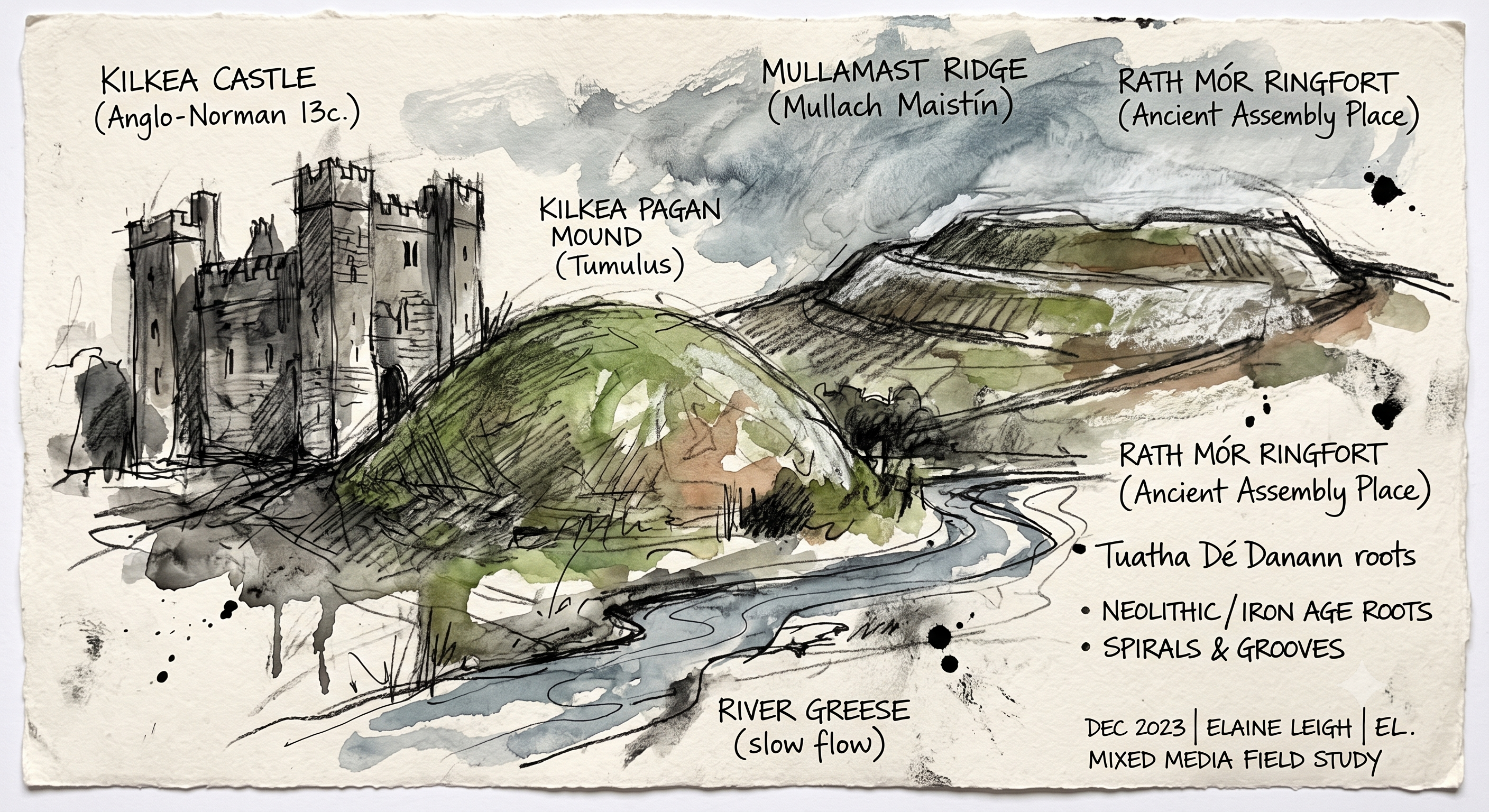
I began the morning in the shadow of Kilkea Castle where the Anglo Norman masonry stands like a hard stony exclamation point over the landscape.
My eyes were drawn just northwest of the bawn where a massive grass covered pagan tumulus or burial mound rises quietly out of the turf. It sits in uncanny proximity to the later Christian burial ground.
This is a recurring theme in the Irish landscape where the layering of sanctity happens naturally.
The medieval and the modern inevitably anchor themselves to the sacred footprints of the prehistoric dead.
Leaving the River Greese behind I walked toward the high ground at Mullamast which translates from the Irish language as the hill of Maistiu.
In the Metrical Dindshenchas this broad crown belongs to Maistiu a woman of the mythic Tuatha Dé Danann who was struck down by the dark sorcery of a jealous fairy.
The air up here is different and feels weighted by centuries of assembly kingship and blood.
Dominating the ridge is Rath Mór a spectacular ringfort that commands the surrounding plains of Kildare. Standing at the center of the earthworks you can see why the early kings chose this as their royal seat.
The ground here is a complex tapestry of Bronze Age barrows and Iron Age enclosures.
I spent hours sketching the space where the Mullamast Stone once stood before it was moved to the National Museum.
It is a portal between eras carved in the deep flowing spirals of the La Tène Iron Age style yet carrying the unmistakable echo of the Neolithic passage tomb art found at Newgrange.
To trace those spirals with a pencil is to feel a continuous line of Irish visual consciousness.
On its edges the stone bears deep violent grooves which folk memory says came from the symbolic repeated striking of weapons during ancient inauguration rituals.
The king bound his steel to the stone and the stone bound the man to the earth.
Mullamast is beautiful but it holds a heavy history.
The earthworks that once held the laughter of ancient festivals and the proud steps of prehistoric tribes became in later centuries the site of a horrific Tudor massacre.
The wind through the grass on the ridge feels less like a breeze and more like a long drawn out sigh.
Visual and Textural Impressions
The gray sharp angled Geraldine stone contrasts sharply against the soft organic green curve of the Kilkea pagan moat.
Chalky white limestone textures break through the deep emerald moss on the high ridge.
There is a distinct rhythm to the La Tène spirals which look like triskeles turning endlessly when the low evening sun catches the slopes.
The palette relies heavily on deep river bottom blacks and oxidized iron rust browns from the wet clay along with the bright aggressive green of well fed Irish turf.
I am inclined to work with heavy weight toothy cotton paper using local river water to wash down dry charcoal blocks so that the grit of the sediment dries directly onto the page.