
The Four True Druids | Cillian Cormac
A hidden island of gravel rising from the pastures near the River Greese where the deep past refuses to be buried. To step within these walls is to trace the very moment where the language of the Ogham scores met the letters of Rome and the memory of the druids became entangled with the saints.
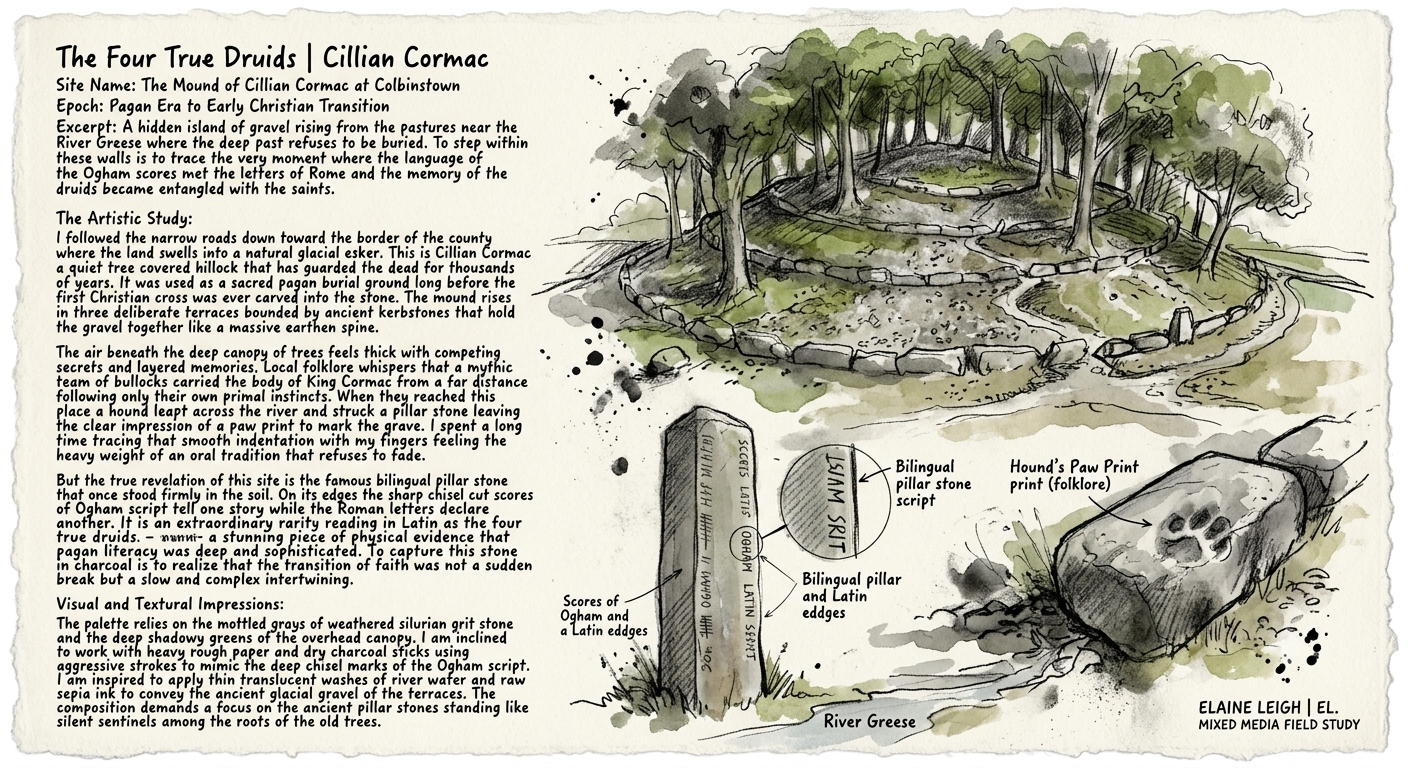
I followed the narrow roads down toward the border of the county where the land swells into a natural glacial esker.
This is Cillian Cormac a quiet tree covered hillock that has guarded the dead for thousands of years.
It was used as a sacred pagan burial ground long before the first Christian cross was ever carved into the stone.
The mound rises in three deliberate terraces bounded by ancient kerbstones that hold the gravel together like a massive earthen spine.
The air beneath the deep canopy of trees feels thick with competing secrets and layered memories.
Local folklore whispers that a mythic team of bullocks carried the body of King Cormac from a far distance following only their own primal instincts.
When they reached this place a hound leapt across the river and struck a pillar stone leaving the clear impression of a paw print to mark the grave.
I spent a long time tracing that smooth indentation with my fingers feeling the heavy weight of an oral tradition that refuses to fade.
But the true revelation of this site is the famous bilingual pillar stone that once stood firmly in the soil.
On its edges the sharp chisel cut scores of Ogham script tell one story while the Roman letters declare another.
It is an extraordinary rarity reading in Latin as the four true druids a stunning piece of physical evidence that pagan literacy was deep and sophisticated.
To capture this stone in charcoal is to realize that the transition of faith was not a sudden break but a slow and complex intertwining.
Visual and Textural Impressions
The palette relies on the mottled grays of weathered silurian grit stone and the deep shadowy greens of the overhead canopy.
I am inclined to work with heavy rough paper and dry charcoal sticks using aggressive strokes to mimic the deep chisel marks of the Ogham script.
I am inspired to apply thin translucent washes of river water and raw sepia ink to convey the ancient glacial gravel of the terraces.
The composition demands a focus on the ancient pillar stones standing like silent sentinels among the roots of the old trees.